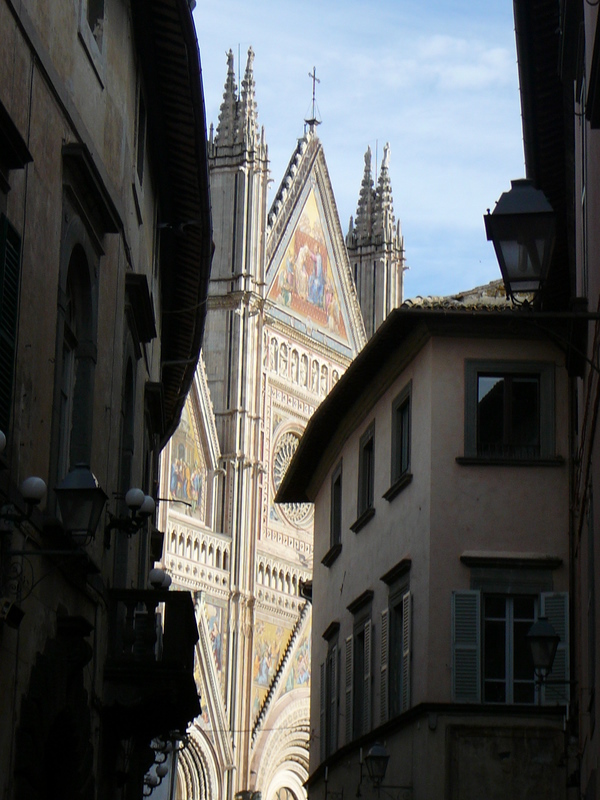
The elegant emblem of a troubled institution
After an hour or so walking into and through the Gothic masterpiece
that is Orvieto's Duomo, a frequent visitor to Italy may wonder how
such a major cathedral could end up in what is today a pleasant but
somewhat minor city. Orvieto's Duomo is one of the top three cathedrals
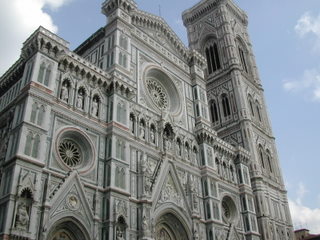
in Central Italy; the other two
belonged to those
bitter rivals who long tried to dominate each other and, in fact,
the whole Mediterranean: Siena and Florence.
But Orvieto? Not only did it lack the power of its rival
Tuscan cities, it also needed to import many of the artisans who worked
on its iconic cathedral. Typically Orvieto's Duomo was often built with
Sienese hands.
[175]
The answer to why Orvieto though, is as simple as the cathedral is
complex. The answer is the pope.
A few decades before work started on the Duomo, Pope Urban IV had made
Orvieto his residence.
[150]
When Pope Nicholas IV blessed the new foundation in 1290 as both
religious and secular ruler of the town as he
was Orvieto's
podestà -- the rough
equivalent of its head of state (or city). Some of the cathedral's
funding came from the papacy as well. Nicholas IV's immediate
successors also served as podesta -- and funded Duomo
construction as well. Both pope and town wanted a cathedral
suitable for a pope. They got a stately cathedral, but not the seat of
the papacy as that institution was about to start its most traumatic
period, moving to Southern France before the Duomo
had exterior walls. By the early 15th century, the
cathedral had its walls and perhaps the most magnificent Gothic facade
in the world. But three men each claimed to be Pope
-- and none of them were interested in Orvieto.
The hands that cradled the rock
As a work in progress over parts of five centuries, Orvieto's Duomo
survived a succession of master architects, some who knew a lot more
about art than construction. Arnolfo di Cambio started in
1290 with a Romanesque layout. (He also served as the chief
architect of Florence's cathedral which started about the same time).
[70]
Lorenzo Maitani took over around 1310 for better (the
façade) and worse (adding useless buttresses that
later were expanded into brilliantly frescoed transept chapels).
Maitani's sons took over at his death and they were followed by members
of the
Pisano family and then by Andrea
Orcagna who designed the magnificent rose window. Several others
followed and the façade was not completed until early in the
17th century
[247]:
Over 300 years in the making including parts of 5 centuries.
But Orvieto's Duomo does more than display fine craftsmanship from the
late middle ages through the Renaissance; it boasts an even
finer paper trail through much of its long construction: Of
great interest to scholars are the substantial archives of the
cathedral, a tribute to the record keeping of the elected
cathedral board of works that built and ran the place. These
provide the foundation for research into the methods and organization
of the medieval craftsmen who came together to build this specific
cathedral as well as suggesting how other medieval buildings may have
been constructed. While sketchy during the first 3 decades, after 1321
the record is rich in detail regarding the contacts binding the
artists, artisans and the materials purchased.
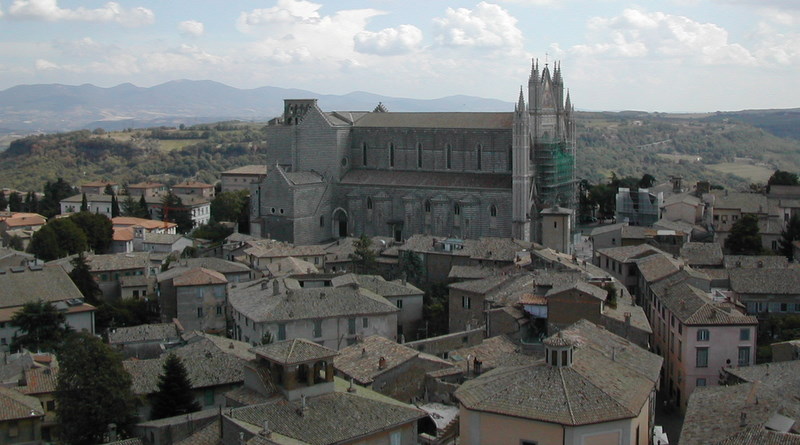
Why you come back to Italy:
the above picture, taken during the 2003 façade restoration,
shows how the Duomo towers over Orvieto.
Let's start where most visitors do: the magnificent cathedral
façade:
Masterpiece in Mosaic and Marble
Orvieto's Duomo is the earliest Italian architectural masterpiece for
which a master plan is available. In fact, two such plans
remain and components from each were implemented. The first
showed the influence of the French Gothic, especially that
of Paris's Notre Dame built about a century earlier (although
it was still incomplete when Orvieto started its build). The
second plan was thought to be by the Duomo's second
capomaestro (chief
architect), Lorenzo Maitani, and reflects much of the work done during
his two decade tenure.
[269,270]
Maitani's plan also suggests the
golden
ratio or "root of two" ratio stretching all the way back to
Pythagoras and the Greeks. (And stretching forward into the
works of Frank Lloyd
Wright and other modern
architects.)
Despite any classic ratios, Orvieto's façade is quite
Gothic. And Tuscan. Orvieto was too small of a town to have
an abundance of craftsmen; it imported its designers and craftsmen from
Florence and Siena. Furthermore, Orvieto wanted to catch up with those
Tuscan neighbors as their cathedrals underwent façade
construction first in Siena and then in Florence.
[690] As
was the case through most of history, technology didn't
transfer unless the technologists moved first. These Tuscan (primarily
Siennan) artisans relocated to Orvieto -- and sometimes went back and
forth to Sienna and Florence as well. In fact, Siena's
cathedral nave continued to rise; so many of these craftsmen must have
returned to that city to add a second story to its facade,
one bearing a
strong resemblance to Orvieto's
mosaic front. So many carvings, so little time.
No expense was spared here. Mosaics cost about 4 times
[73]
what murals do.
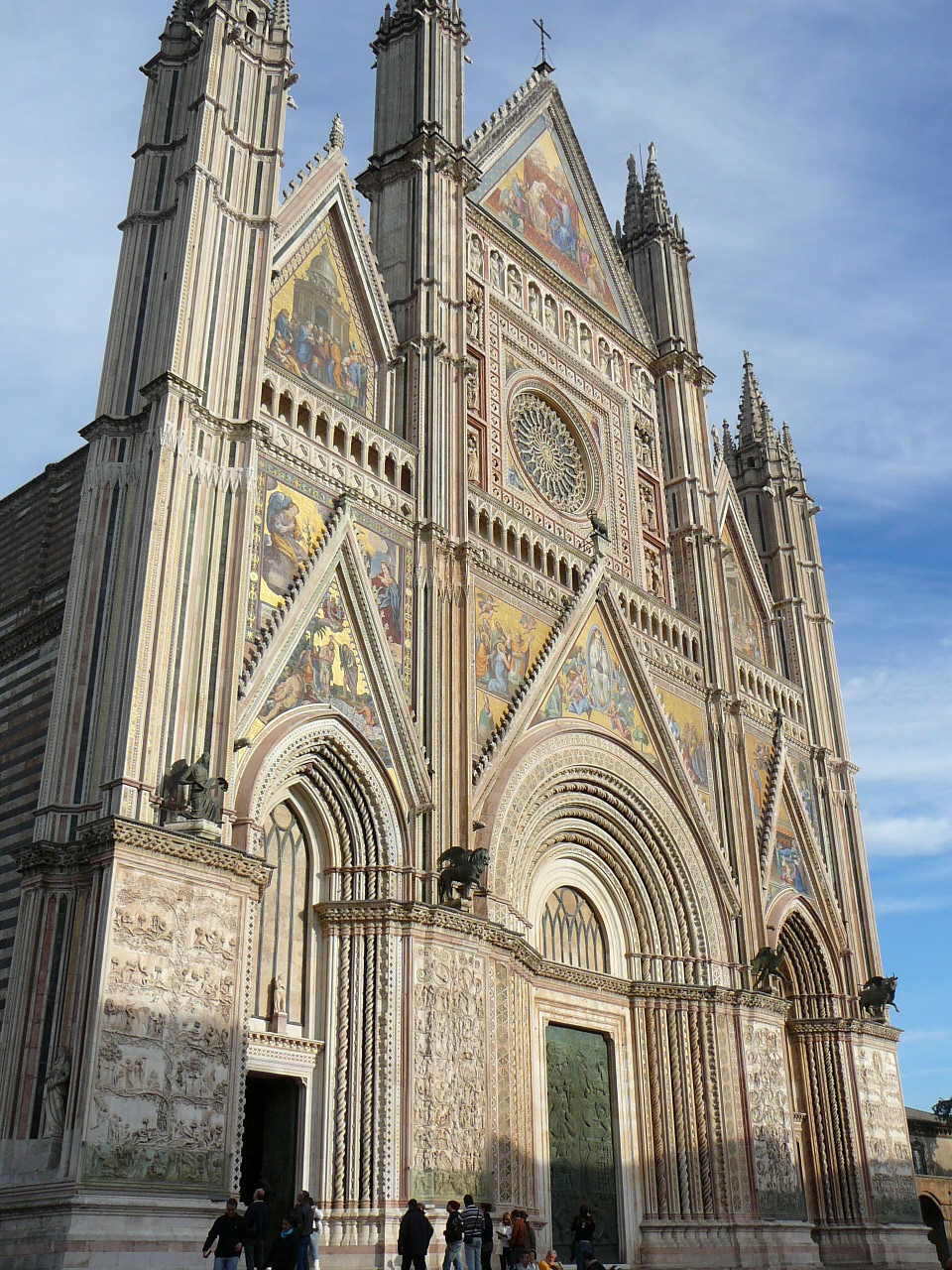
The façade gables highlight many crucial scenes from the
life of the Virgin Mary in stunning symmetry with her assumption into
heaven and coronation between the slender spires that frame the
cathedral's center.
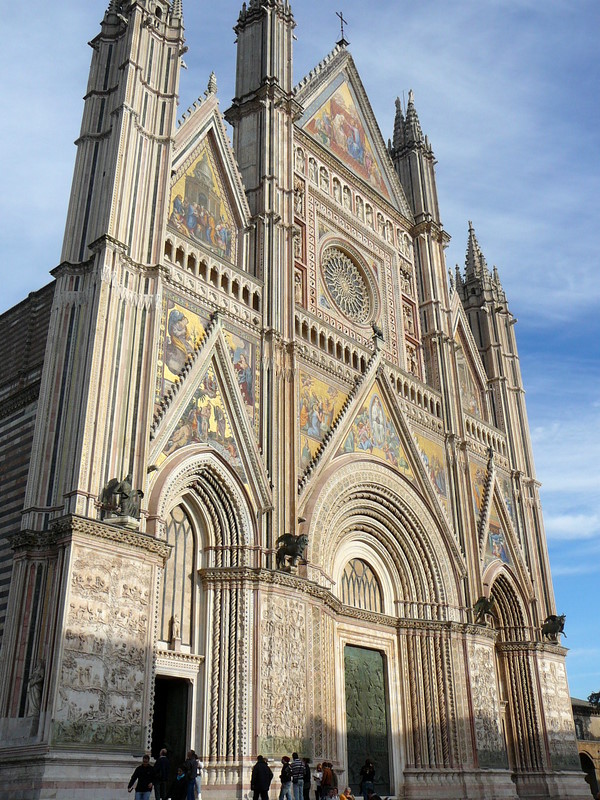 Left: Radiant in
mosaic and marble, Orvieto's Duomo façade
dominates the Piazza Duomo.
Left: Radiant in
mosaic and marble, Orvieto's Duomo façade
dominates the Piazza Duomo.
Mosaics
A first impression of the Duomo is a bit overwhelming, primarily due to
the glittering mosaics on the façade: A golden Gothic face
on a Romanesque body. As in most of Europe's great cathedrals, visitors
see mostly reproductions on the exterior with the sculpture and other
art long moved indoors to preserve it. But unlike many of
these cathedrals, the restorations here are typically not mere copies
of what came before, although they appear to depict the same Christian
legends. Instead, restorers viewed themselves as artists in
their own right and created new images. However, it appears
that with the exception of the topmost gable, the overall subject
matter reflects the original framework of Marian lore created by Siena
architect Lorenzo Maitani around 1310.
It took most of the last half of the 14th century to complete these
mosaics, starting around 1350 and mostly ending around 1390, and even
then the capstone Coronation at the very top gable had yet to finish.
The first Restoration started about 100 years later in 1484.
Today only part of one mosaic contains original stone.
[90,75]
Mostly what we see are "imaginative" reconstructions (actually more
like reinterpretations) from the 17th through 19th centuries.
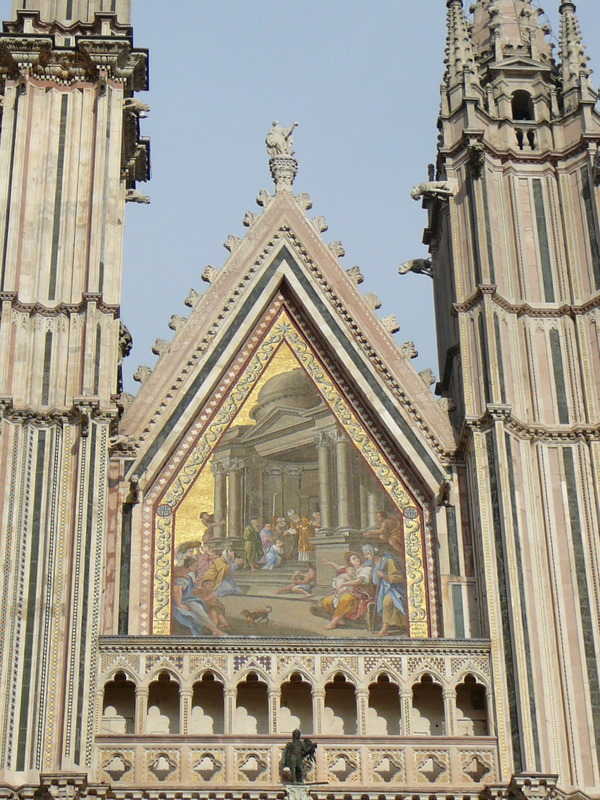 [247]
[247]
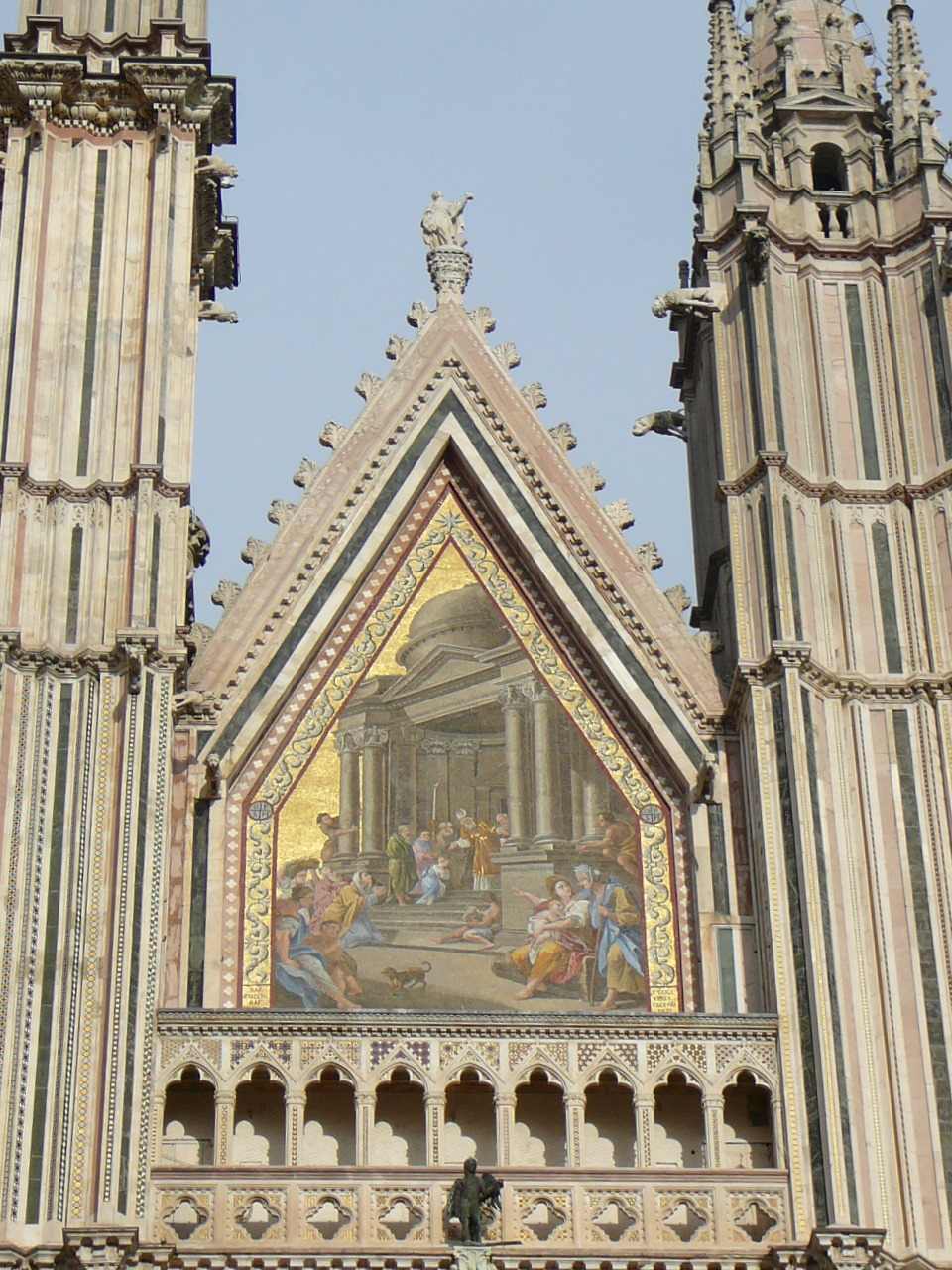
Right: a 17th century version
of Mary's presentation in the temple. By the time
many of the original mosaics were redone, the artists would draw
cartoons and the artisans would cut and embed the glass into the mortar.[15]
Note also the nine
carved niches (aedicules) which underline many of these gables and
brandish almost Moorish elements.
Catherine
Harding of the University of
Victoria has
researched the cathedral's archives in order to
reconstruct the social organization and methods needed to sustain the
significant mosaic project necessary to create this key component of
this magnificent façade. A well documented and
preserved paper trail from 1321 through 1390 allows her to
describe a well organized and hierarchical workshop
which allowed apprentices to spend their whole working lives creating
this façade. They would rise literally on a career ladder
(scaffold) from laborer in the on-site factory to apprentice to glass
cutter to master glass artisan. Some such as Fra Giovanni Leonardelli
would begin their careers at Orvieto as glassmakers and later work on
murals in the inner chapels.
[83]
And no one got kicked upstairs: Andrea
Orcagna created one of the
façade mosaics and designed its rose window --
after he became the
master builder of the entire cathedral in 1359.
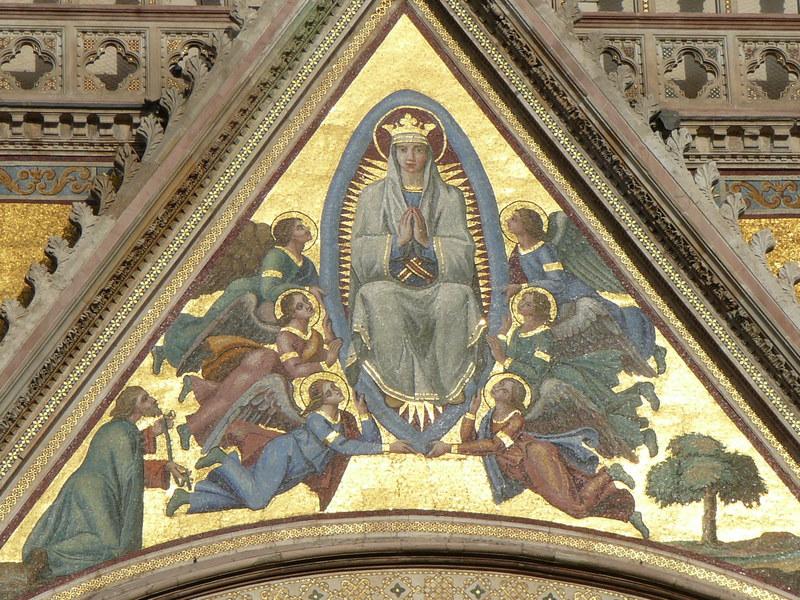
Above: the Assumption of the
Virgin into Heaven. The original (long removed) was by Fra
Giovanni Leonardelli.[17]
In many ways, the Orvieto mosaics show the technical transition
from Byzantine to the Renaissance practice. Much as
in the old way, the Orvieto artisans cut the glass and embedded it in
the mortar with their own hands. The vision and the hand were
one. But as time passed, they began to rely more on external
drawings and/or drawings on the mortar, allowing lesser
skilled craftsmen to cut and embed the tesserae. This is
similar to how the Renaissance masters Titian or Tintoretto created
cartoons for others to implement on Saint Mark's in Venice.
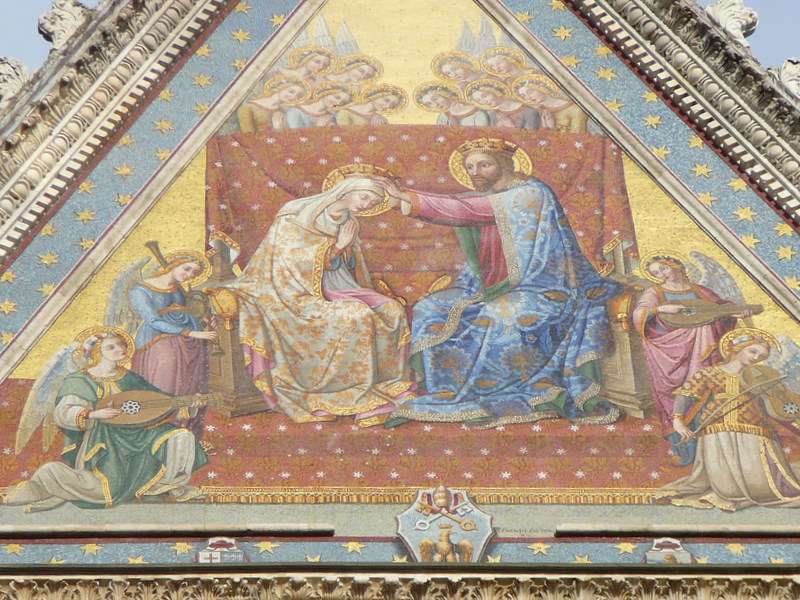
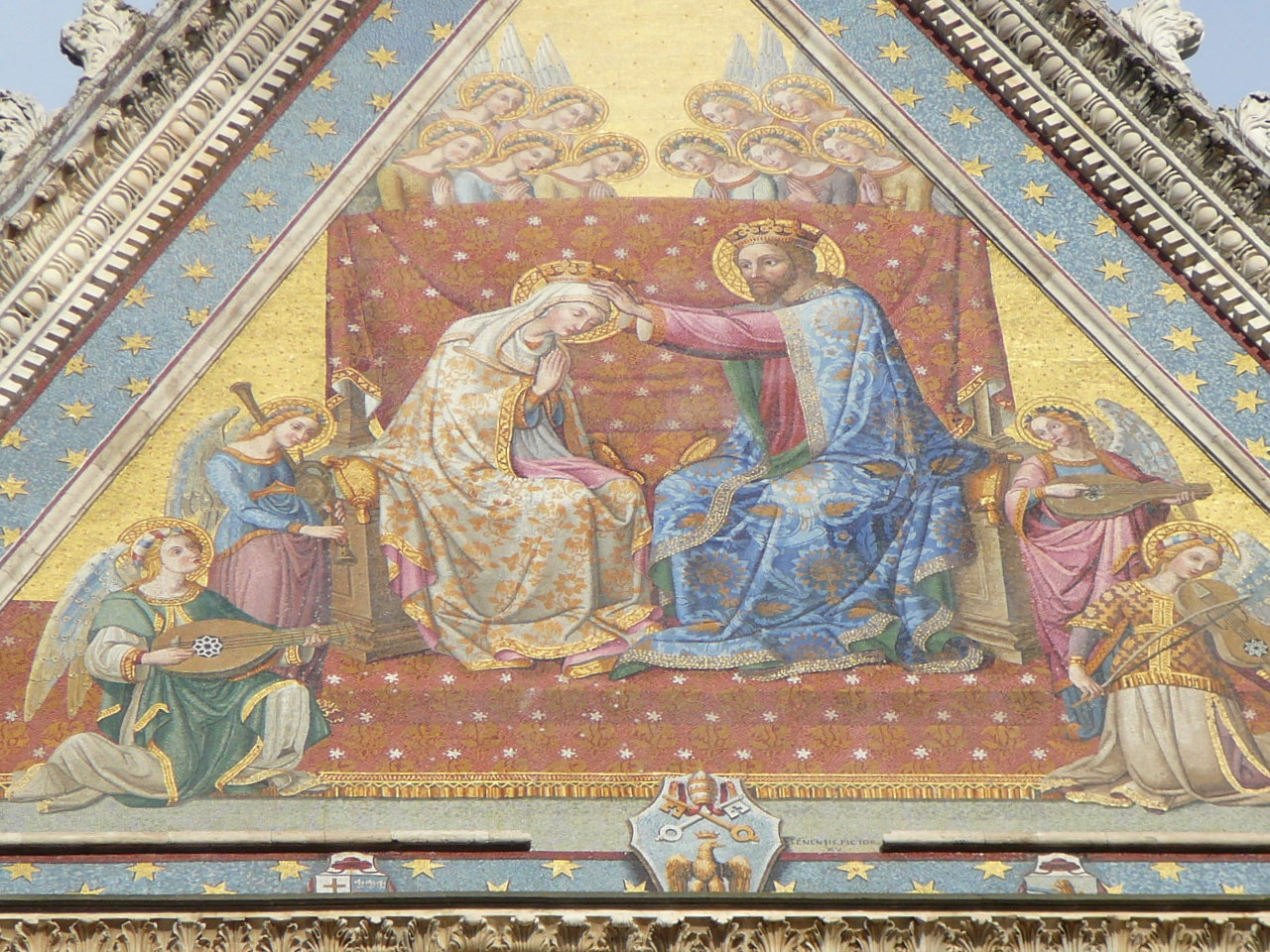
Above the crowning mosaic:
Jesus crowns his Mother as Queen of Heaven in the uppermost gable on
the Orvieto façade. The space started with a
resurrection scene but became one of the few gables replaced by a
totally different episode, in this case that of the coronation (first
in 1714 and then by this mosaic from cartoons by G. Bruni in the 1850s).[15]
Blue stone was rare
and expensive but used lavishly here.
Here's a tidbit for those of you interested in project management
(especially for a masterpiece 300+ years in the making).
Often the master artisans would not know what they were to be
paid until they finished their mosaic. At that time a group
of artists, some representing the cathedral works board and some
representing the artist, would negotiate what the project was worth in
a process called
lodo.
[87]
This process was used to determine compensation for even as
prestigious an artisan as Andrea Orcagna, the most prominent 14th
century painter and architect in
Florence.
See all of the mosaics on the façade on our Appendix A page
by clicking here:
Orcagna's Rose Window
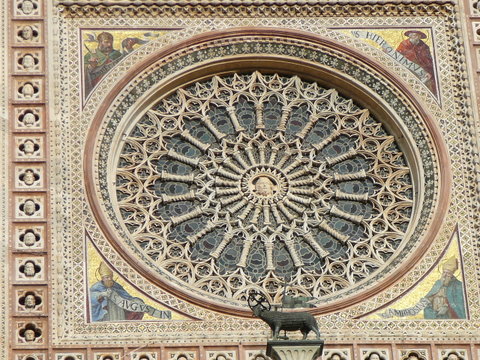
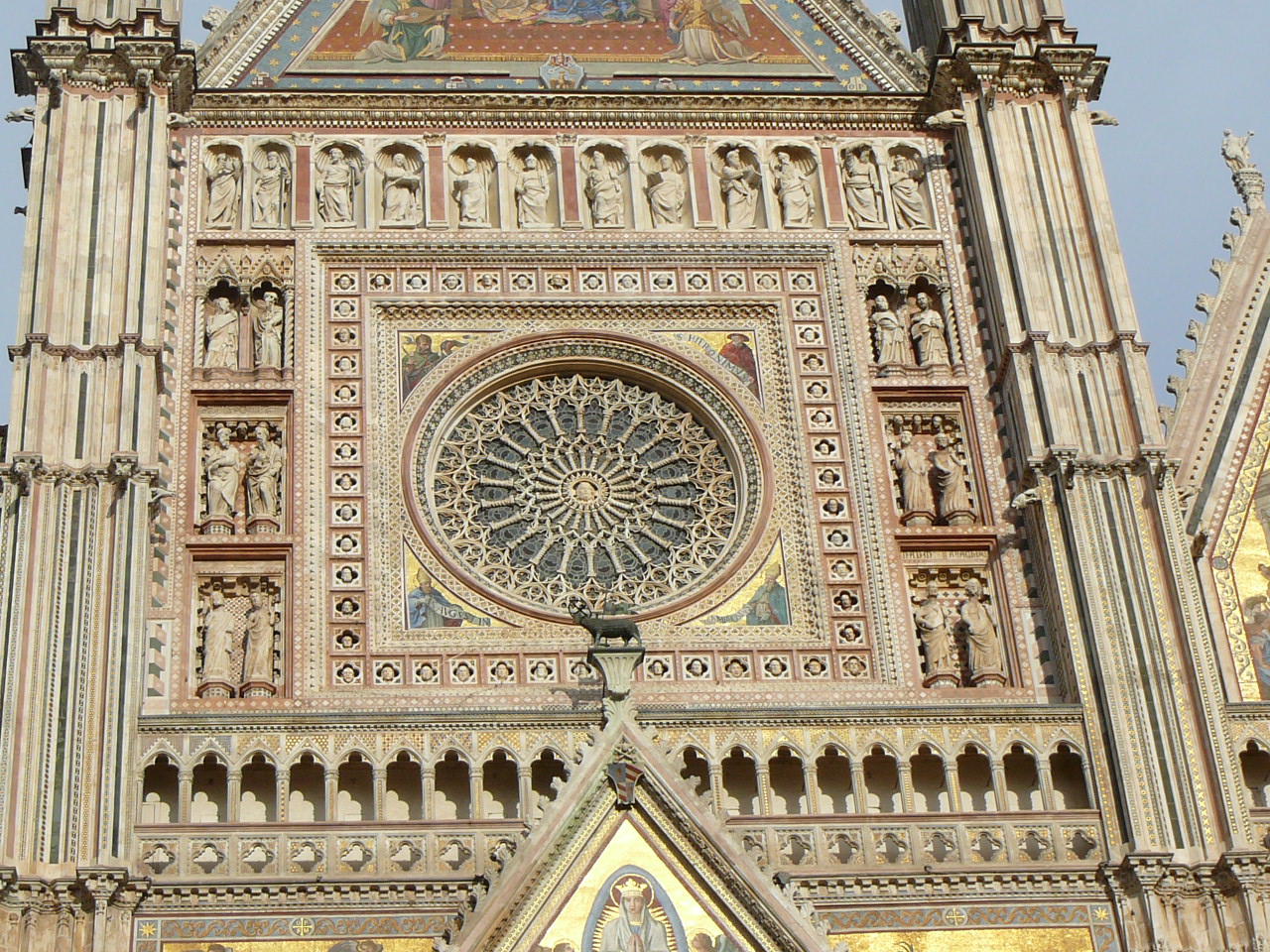
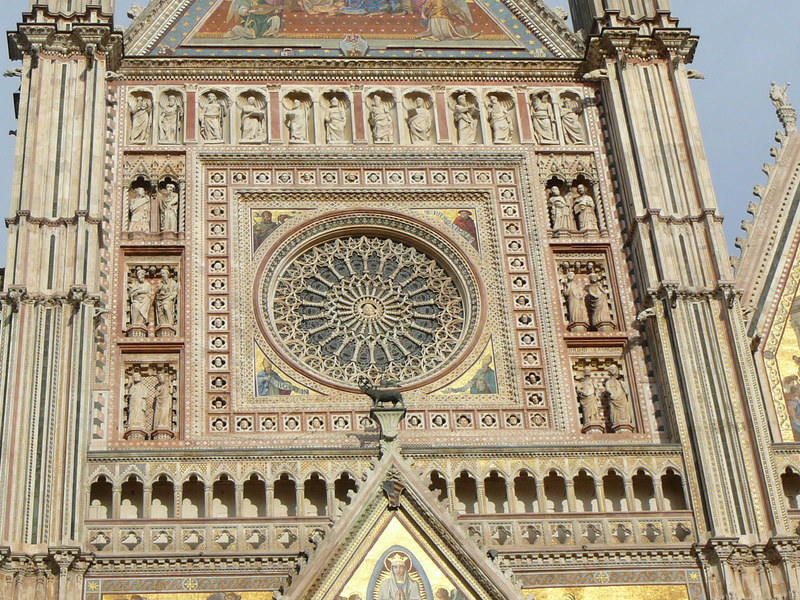 Above: the prominent
Florentine sculptor and architect Andrea Orcagna's Rose Window
above two sets of nine niches called
aedicules. Christian architects loved the number 3
and its square 9, making them here into rectangles.
Above: the prominent
Florentine sculptor and architect Andrea Orcagna's Rose Window
above two sets of nine niches called
aedicules. Christian architects loved the number 3
and its square 9, making them here into rectangles.
What's a Gothic cathedral without a west Rose Window?
Orcagna's is centered on a head of the Redeemer radiating
outward to mosaics of four of the Doctors of the Church. On
either side are niches containing pairs of twelve Old
Testament prophets. Below are eighteen niches and above stand
the New Testament twelve apostles. At center is a bronze of
the Lamb of God.
Statues in niches is a common characteristic of the great French Gothic
cathedrals built about a century before the Italians got into that
business. (Check out the statues of Notre Dame
by clicking here). It's
likely that many of the Italian carvers working on Orvieto's facade had
traveled to France and were influenced by these stone masterpieces --
but then went their own way. Eight of the statues here are
attributed to a minor Italian sculptor, Nicola de Nuto.
[300]
|
|
| The Redeemer at the center, four
doctors of the church at the corners |
(Click on these images to see
screen size enlargements) |
While serving as the master architect here in Orvieto, Orcagna also
commuted back to his home town of Florence to help build their
cathedral as well. While in Orvieto, he was also the master
craftsman for the scene of the Baptism of Jesus once seen above the
left door. By then (1358), he was an expert in drawing and painting and
so the Duomo committee thought he would also be capable in mosaics.
However, his work in this new medium deteriorated rapidly.
[73]
As an architect, sculptor, painter, and poet, this early Renaissance
man may have spread himself or his mortar too thin -- but Orcagna's
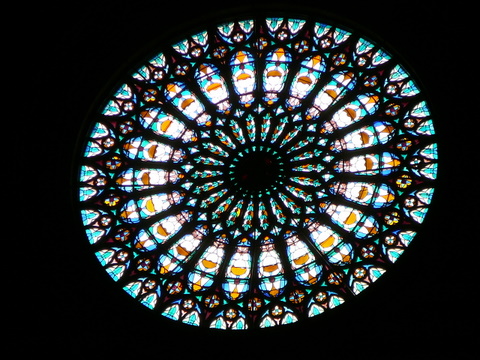
Rose Window still filters its kaleidoscopic light into the cathedral.
The Orvieto Marbles
While the glistening mosaics make a stunning first impression, tourists
quickly migrate to the lower-level pilasters which display
bas-reliefs, separated by acanthus branches, depicting the Christian
religious view of the history of man (including that which is
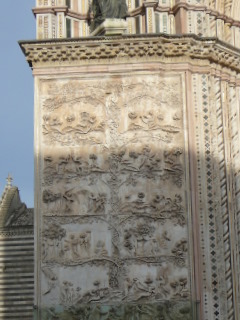
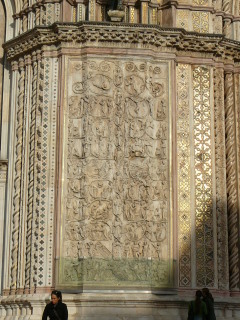
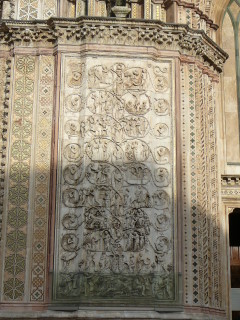
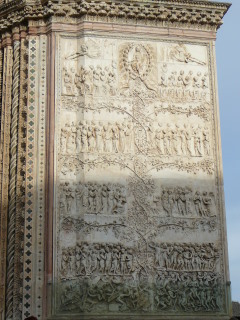
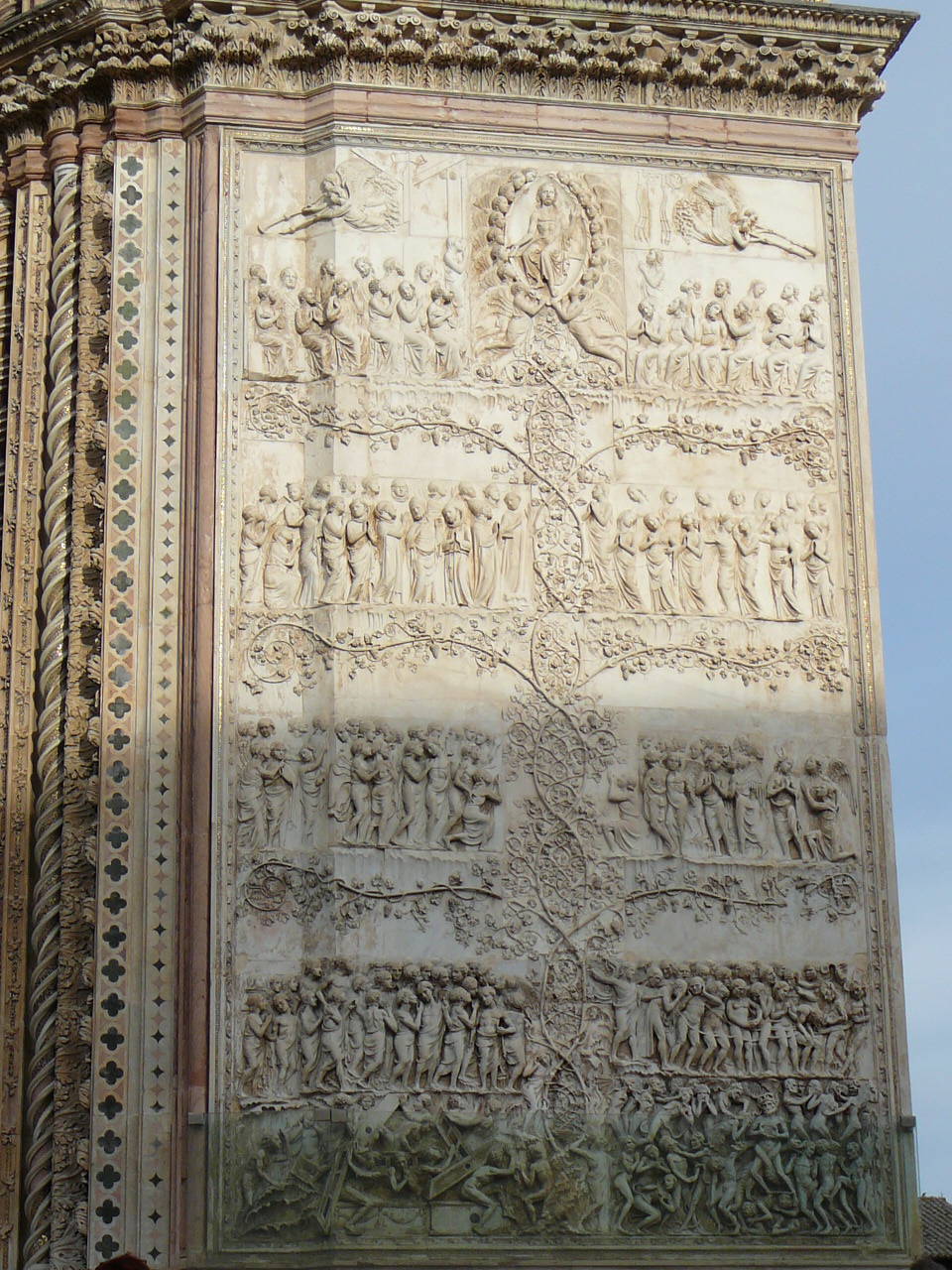
to come!) in 2 wide and 2 thin marble "albums." Click on these pictures
below to see screen size renderings.
|
|
|
|
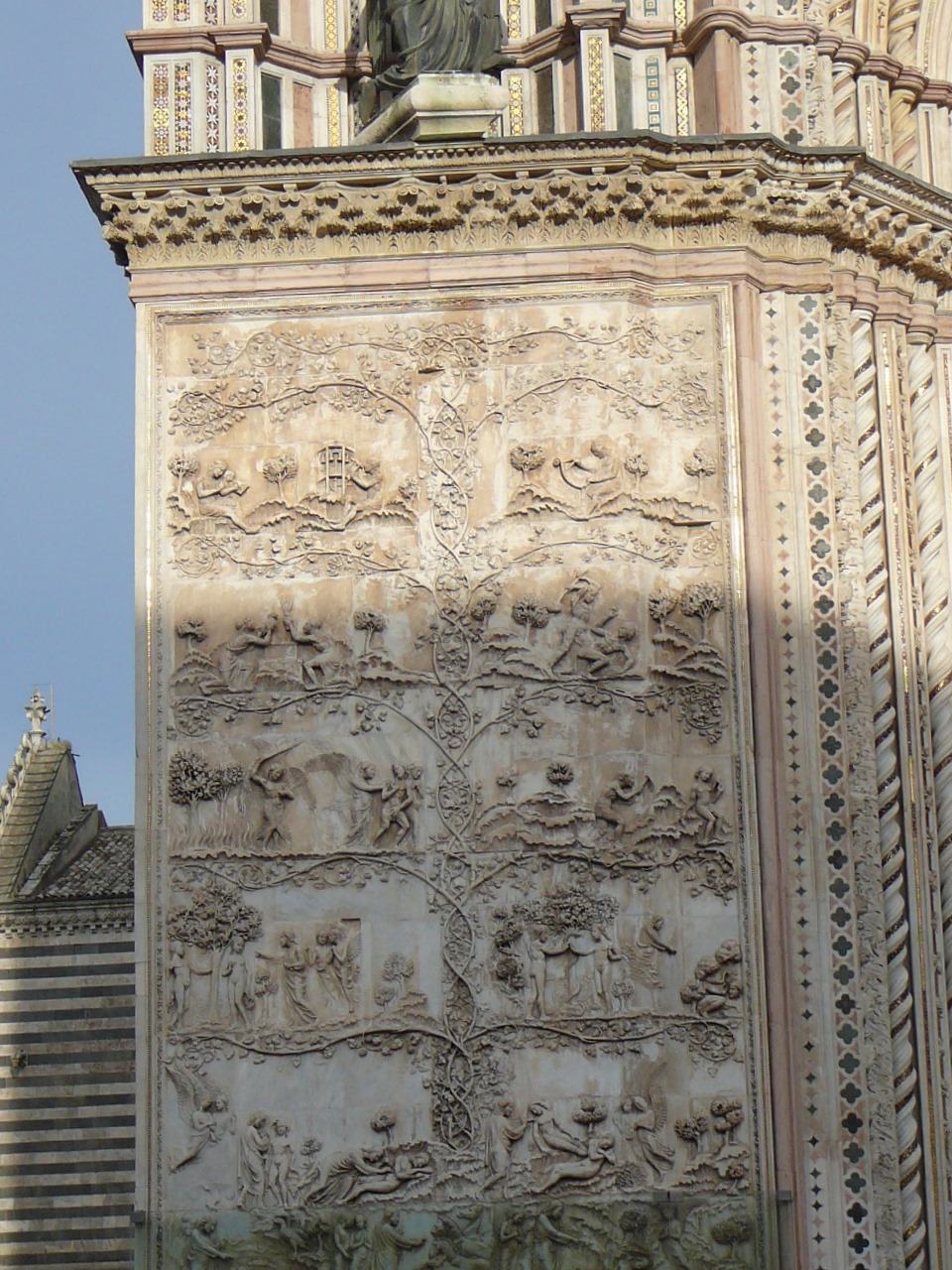
| Northwest corner:
the Book of Genesis |
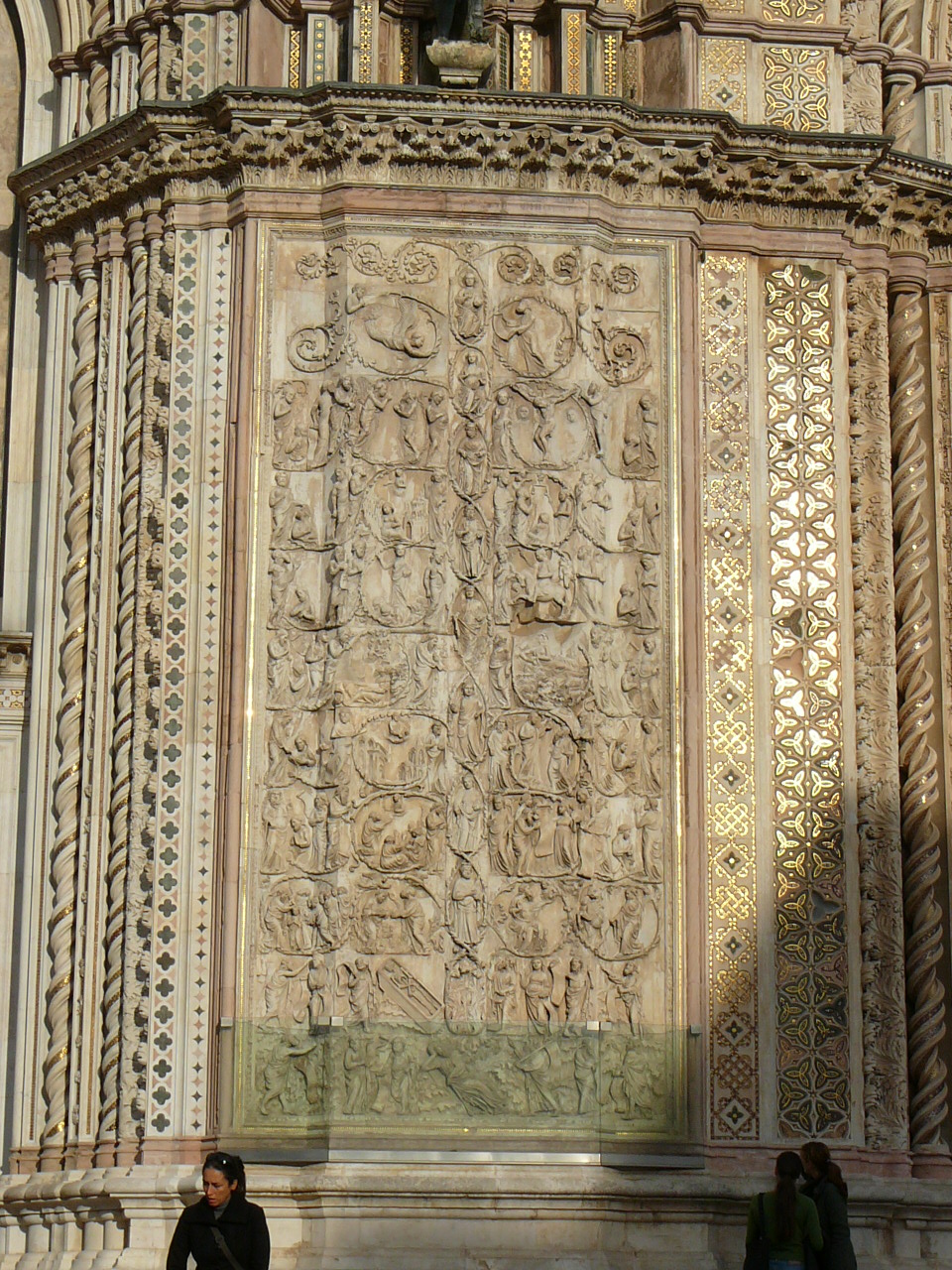
Central left: the
Tree of Jesse. (Middle pillars are thinner than) |
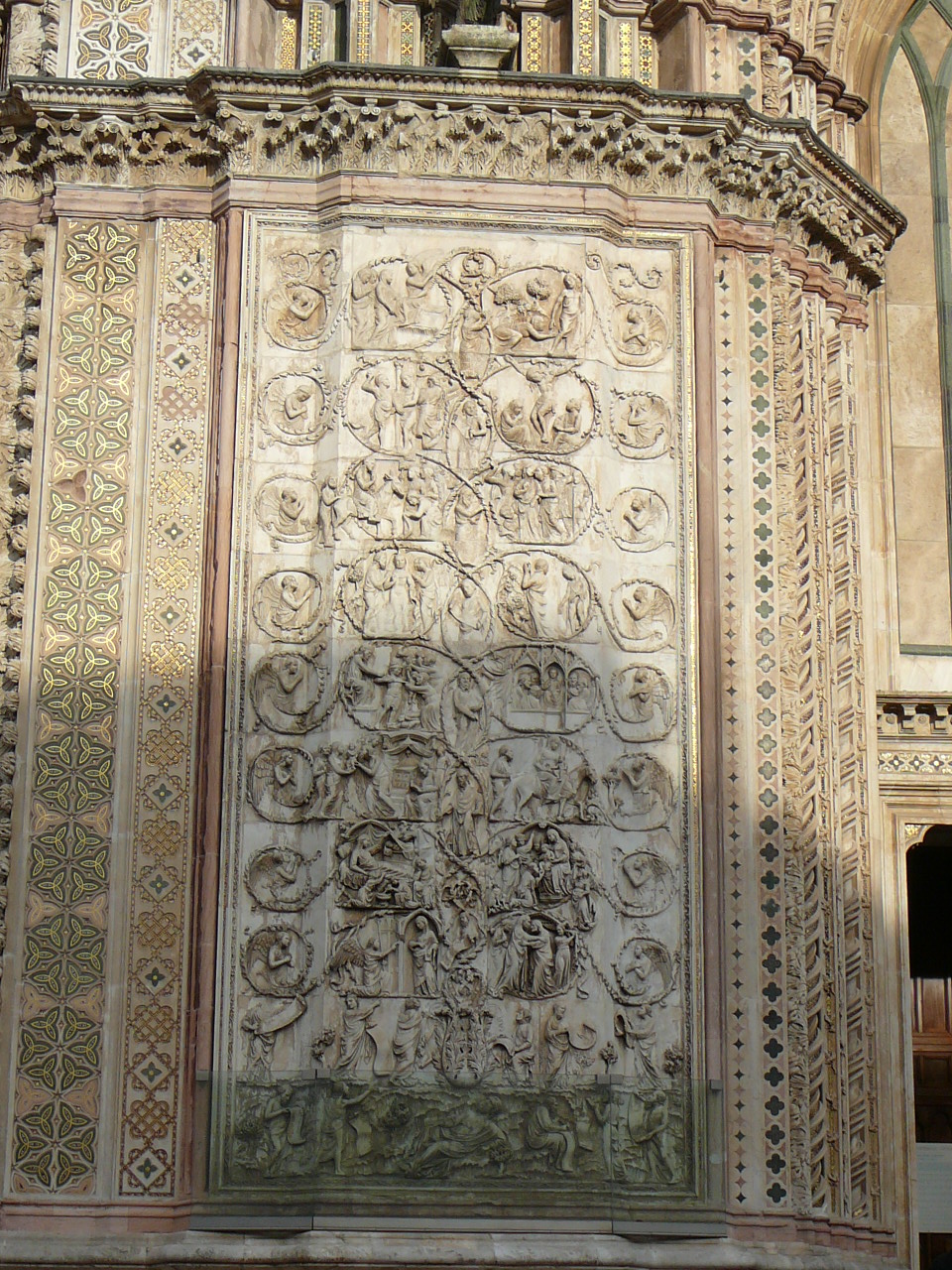
Central right:
Episodes from the lives of Jesus and Mary |
Southwest corner:
the Last Judgment |
The marble carved covering
for the four piers on the lower level of the Duomo
Like the later gilded mosaics rising above them, these carvings on
these piers demonstrate a high level of
group craftsmanship.
These are products of the Gothic age where work was
both
communal and anonymous. The Renaissance would soon enough
produce
artists trying to convince the West of their individual and
often
branded genius. Here several masters, along with teams of
assistants, worked to produce scenes that unite religious iconography
from the Old Testament (Pier 1's depiction of the Book of Genesis),
through the New Testament life of Jesus and Mary on Pier 3, until its
culmination in the Book of Revelation's Last Judgment on pillar 4.
Uniting the Old and New is Pier 2, the Tree of Jesse that
linked
the Hebrew King David to his descendant Jesus or Nazareth. In
terms of artistic expression, these presage the Renaissance; in terms
of promoting artists, they are delightfully anonymous Gothic.
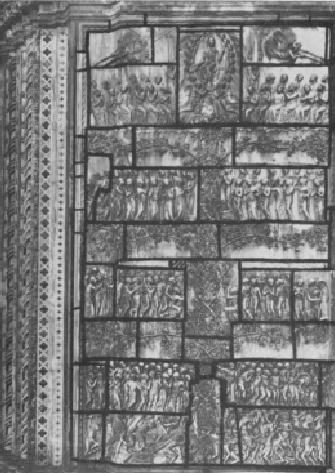
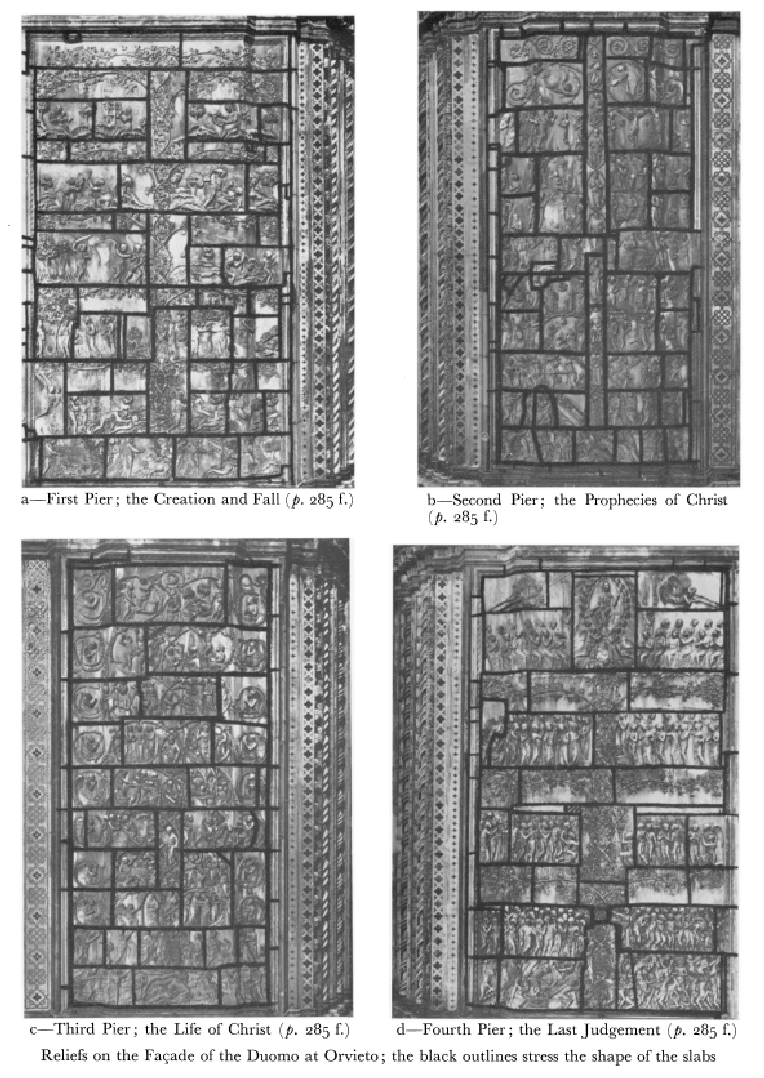
While at first glance the piers appear to be each cut from four pieces
of marble, they are in fact 162 different slabs. At
right is John White's diagram of the components of Pier 4 -- the Last
Judgment.
[284]
The stones appear to have been carved, at least in rough form, upon the
ground and then raised into position.
[297]
A completely finished panel would have five or so separate
steps including final polishing. These steps would be completed on the
ground and then the slab would be hoisted into place. Work
proceeded from the lower scenes to the higher. However, many
of the higher scenes were left unfinished. No one
is sure why.
The Master Builder
Around 1308, a generation after work on the Duomo began, a new master
architect, Lorenzo
Maitani was hired from Siena.
Most likely, he proposed the overall design for the whole
façade, including these marbles. Although these
marbles are unsigned, it is likely that the first (Genesis) and fourth
(Last Judgment) piers are primarily his work as well.
[254]
He also did some of the bronze statues and had other
responsibilities in Orvieto such as supervising the construction of
bridges. Perhaps Maitani was a renaissance man in a Gothic
time, but not quite an engineer: He added unneeded buttressing
to to the choir area, thinking it would fall down without it.
[261]
;Maitani served at least 21 years as capomaestro (chef architect);
unfortunately, documentation is quite sparse during his tenure.
After his death in 1330, he was succeeded by a team
of 3 including his 2 sons.
It is also likely that the greatest Gothic sculptor
Giovanni
from the great sculptor family, the Pisani, created some of these
reliefs, and clearly some scenes from the New Testament were at least
"inspired" by the reliefs on his Gothic sculptural masterpieces that
are the pulpits in Pisa and Pistoia.
[298]
Despite these big names, the Orvieto Duomo marbles appear to seamlessly
unite the efforts of at least 3 or 4 masters and many more members of
their workshops. Despite the cathedral's paper trails and
scholarly analysis of carved faces, hair, draperies, foliage, or
whatever, no individual carver can be attributed conclusively to any of
the reliefs. These reliefs are collective, anonymous,
and Gothic -- unlike the output of the highly
individual Renaissance sculptors who were to follow. While
these anonymous artists carved their stone, Andrea
Pisano was ushering in the
Renaissance through the
bronze doors of Florence's
Baptistery.
Pillar of Length: The Jesse Tree
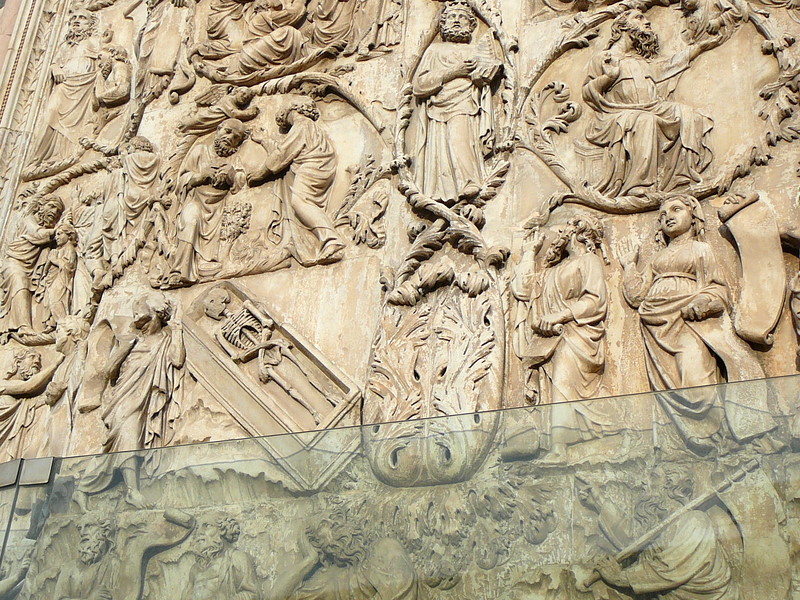
Pier 2 holds the Tree of Jesse branching from Jesse (just below the
center of the picture) rising in an Ancthus vine to his son David ...
and then upward to Jesus, the son of Joseph and Mary (both thought to
be of the House of David as medieval lore felt that the members had to
marry within the House of David.) Not only do the Davidian
kings appear here, but also "pagan" prophets such as Virgil and the
Sibyl -- attesting to the appeal of Jesus as Lord of all.
"There shall come forth a shoot
from the stump of Jesse, and a branch shall grow out of his roots."
So says the prophet
Isaiah looking forward to the New Testament in predicting
that the Messiah would descend from the Old Testament David (Jesse's
son). Looking backward, the Evangelist Luke listed all 43
generations between the Jesse and Jesus.
As the iconic link between the Old Testament (as seen on pillar one)
and the New (pillar 3), the Jesse Tree is a natural for pillar 2 -- but
it is much more than that. Cathedral architects had a rich
set of Christian iconography to decorate their work -- why pick a
symbol usually relegated to one of many stain glass windows (as it was
at York Minister. See this oldest stain glass in England
by
clicking here). Historic drawings of the cathedral
show the Jesse Tree as among the earliest of ideas for the
façade. The acanthus vines on the other pillars
reflect the foliage required to depict the Tree of Jesse. Why let this
fairly obscure symbol drive the presentation of the much better known
scenes of Adam and Eve and the Crucifixion?
The answer appears to be historic. The popes were gravitating
to Orvieto as their second home and this cathedral was to make a
statement to thwart the
Cathari or Albigensian heresy that
they had been fighting during the century before the Duomo started.
The heresy attacked Christian institutions as well as dogma.
By 1200, the Cathari had 11 bishoprics including 6 in Italy.
Their rapid spread must have been through conversions, for
their dogma held all of the material world to be evil -- and therefore
outlawed sex. By the time the Duomo was built, the Popes had
pretty well wiped out the threat -- but they didn't know that.
Generals and Popes are always fighting the last war, and so
they had a template created to use the Tree of Jesse to emphasize the
human roots of Jesus. If God came from the world and had a human body,
then the Cathari who held everything material was evil must be wrong.
This pillar then was a bold refutation of that heresy and a
tribute to the Catholic doctrine of Incarnation (the Word made Flesh.)
[143]
Jesse Trees had long graced the walls and windows of Western churches,
but Orvieto's is the first of a new breed apparently commissioned by
the Pope around 1260.
[145]
The Balkan areas were also assailed by the Cathari.
[161]
and appealed to the Popes for assistance. Eventually the
Jesse Tree first laid out on Orvieto's façade found its way
to 18 churches there, an unparalleled migration of an archetype into
the Eastern Orthodox realm. Orvieto's particular brand of
Jesse Tree with supporting prophecy from Virgil and other pagan
prophets is found nowhere else in the Western world.
Fit but not finished
Unfortunately, work on the bas-reliefs stopped before all of the
figures received their final touches.
[254]
In nearly every case, however, a true master at least roughed
out the scene. Minor artists appeared to specialize in
various details, such as angel wings or hair. These details
are mostly complete throughout the piers. However, the
masters who completed faces, limbs, and flowing garments didn't always
get to finish -- perhaps because their skill created a demand for their
service in other projects in central Italy. (For instance,
Florence and Siena were building portions of their cathedrals at the
same time.)
One might argue that our modern, sometimes microscopic, perspective
literally was unexpected by these artisans. Nowadays, sculptures
originally positioned high on façades and meant to be viewed
from the ground may be seen at eye level in museums and/or photographed
close-up and in unnatural light.
[690]
Sculptors can go to the dark side and employ shadow as well as light.
In fact, most of the pictures on this page were taken with telephoto
assistance from 1 to 10 times enlargement. Were
these higher reliefs left unfinished because the artisans didn't expect
anyone from ground level to notice? Maybe on some churches,
but probably not at Orvieto, where fingers and hair could be finally
finished while limbs and faces remained rough.
The third pier dealing with the New Testament scenes from the life of
Jesus and Mary is a case in point, especially in the higher rows which
are, of course, far from the eyes of the viewers on the ground.
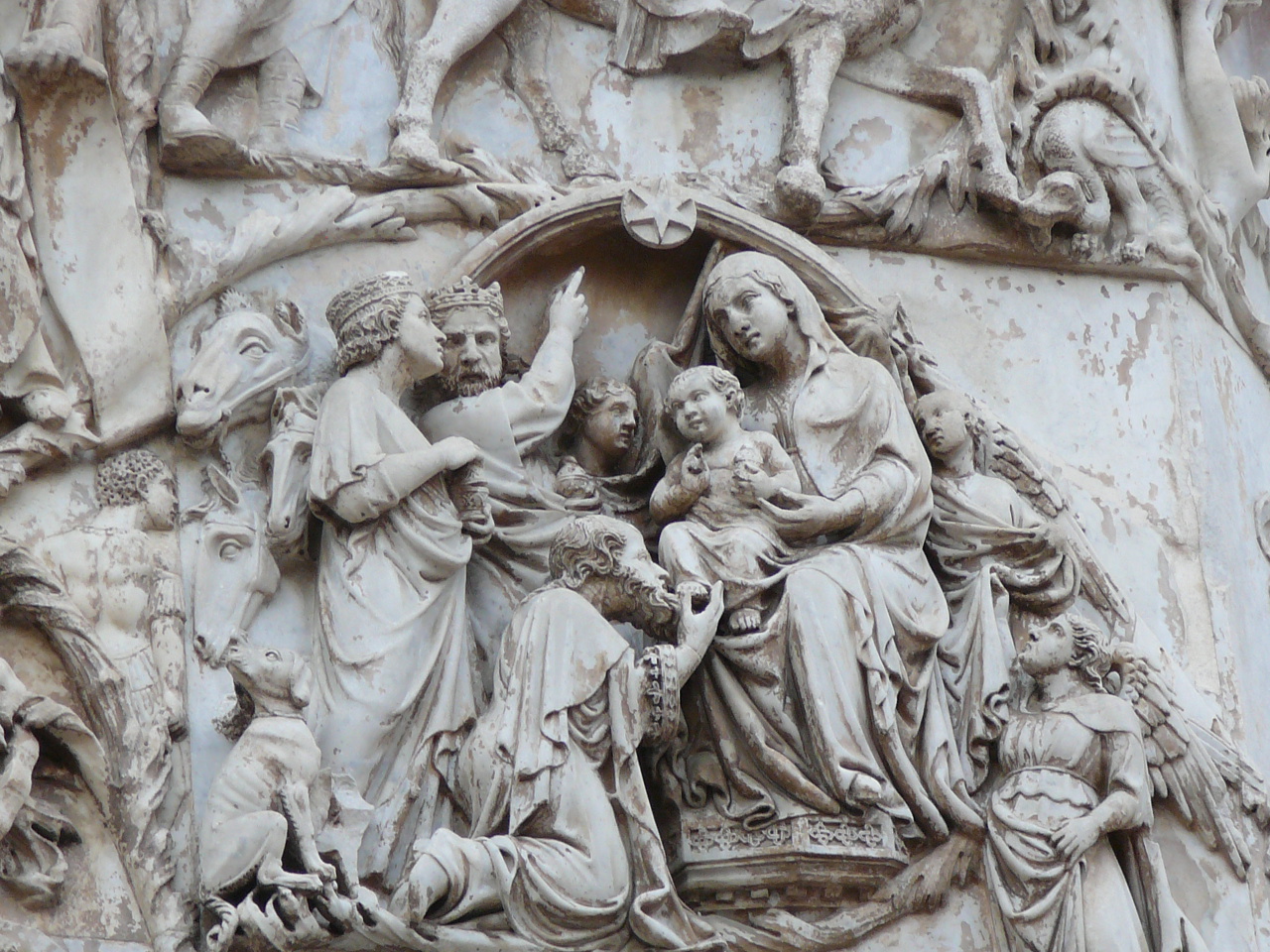
Let's start with a well-finished scene: Below is a lower
rendition of the Three Magi visiting the Christ Child. Examine this a
moment (or click on the picture to get a screen size view).
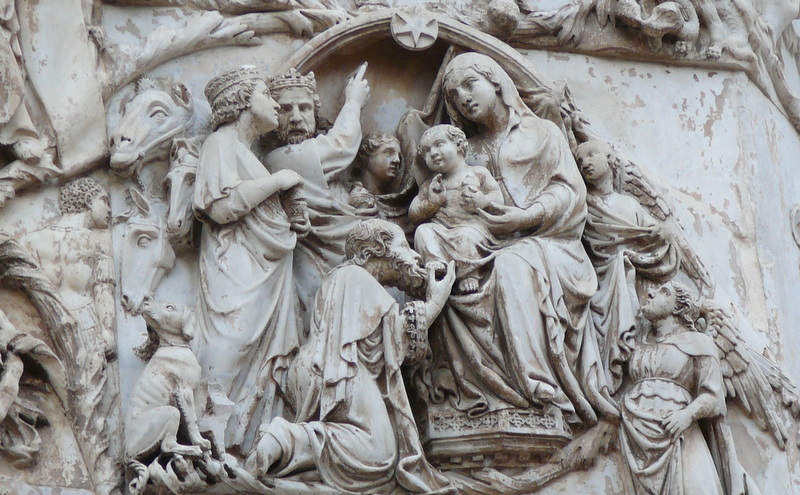
Pier 3: The Visit of the Magi
to the newborn Christ Child
Like nearly every scene on these 4 pillars, the position of the
characters and their facial expressions well convey the dramatic
essence of the religious episode. Unlike some (especially the
higher) scenes, all five carving stages are complete. Clothes
show folds, marble has been polished, limbs and fingers are detailed.
Here also the joining of individual slabs together is obvious
at left as are some of the detail work on Mary's pillar, the
Magi's crowns, hair, beards -- and the angels' wings.
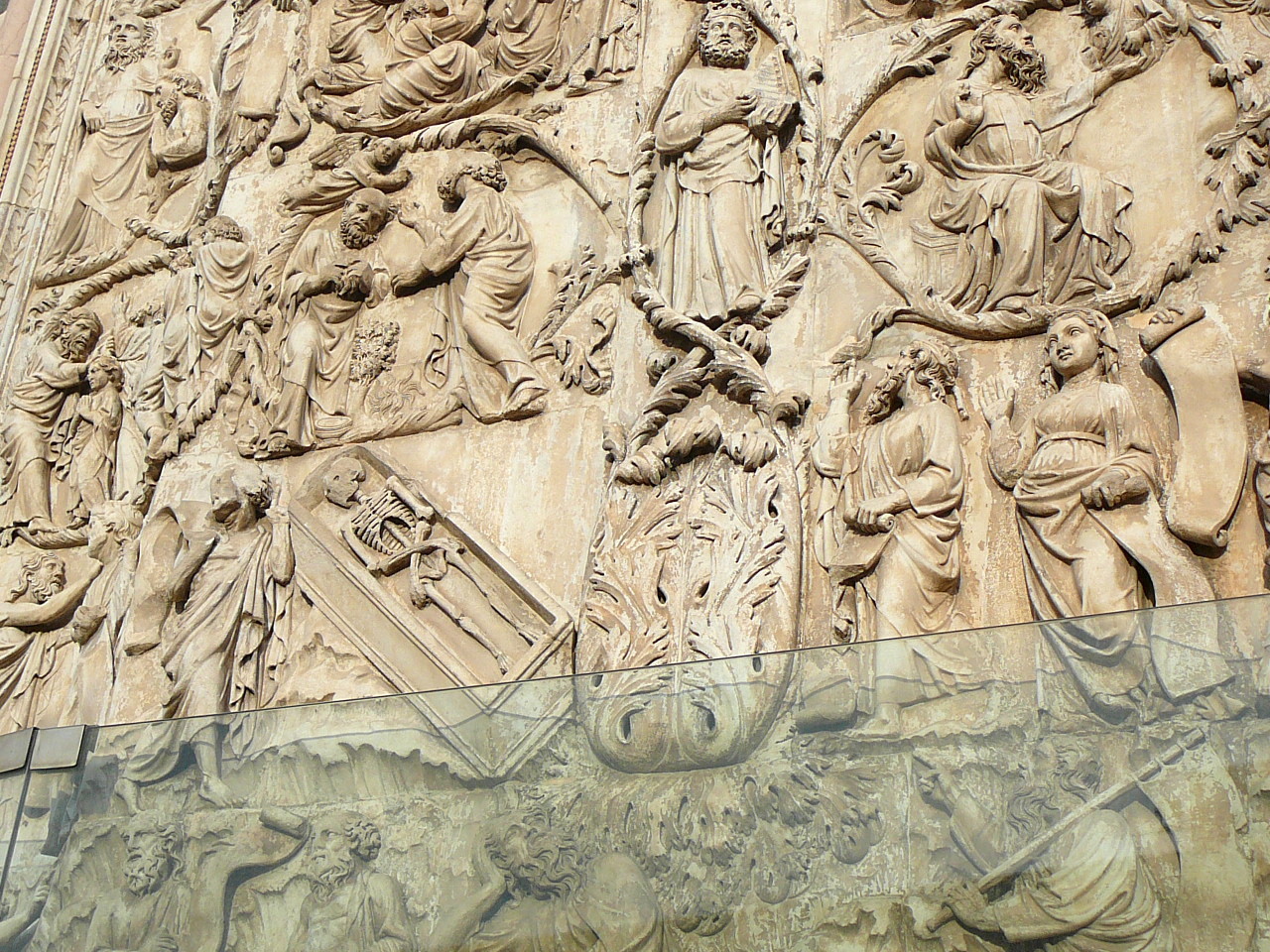
Contrast this with the view below of the right figure which, I believe,
is of the devil (perhaps always a work-in-progress) attempting to tempt
Christ:
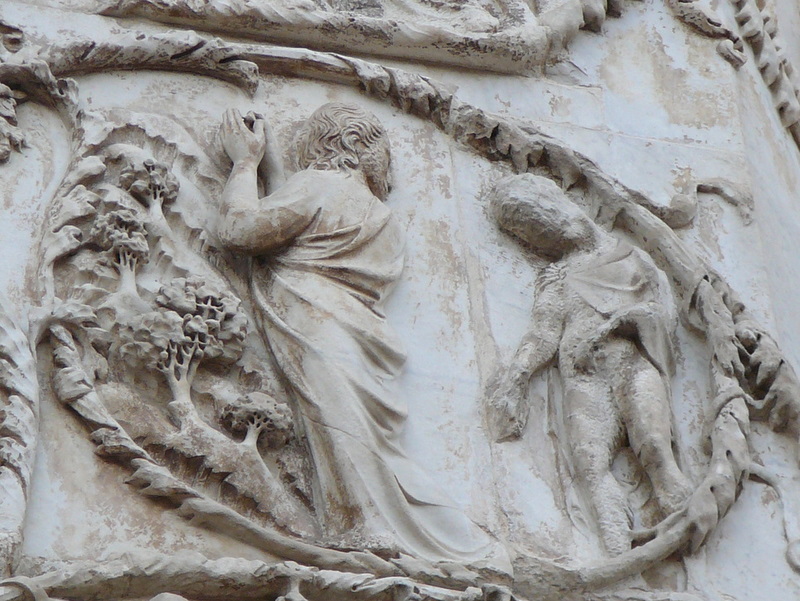
In this case, Christ has been in the desert for 40 days, but he still
looks better than Satan whose face has yet to be carved (however, the
brooch holding his cape around his shoulders appears better completed.)
The trees in the valley below seem to show the most finish.
Christ's left elbow appears in need of chisels (but his hair
is nicely combed). (Many more scenes are depicted in the
slideshow available by clicking on the right side).
The devil is not always in the details
John White
[290,291]
uses scenes such as the Temptation (above) to support his
theory that 3 or 4 individual masters would rough out all 162 tablets,
allowing lesser carvers to specialize in hair,
beards, wings or sleeves. Being in less demand, these
specialists would finish first -- leaving this unfinished masterpiece
with highly refined sleeves but perhaps crude hands, well combed hair
but vague faces, etc. But from a distance, it all works well.
The few hands who did the rough cuts well understood how to
extract the drama of Scripture from marble. And
probably for just that reason, these anonymous masters were pulled for
other projects in late medieval central Italy. Seven
centuries later the overall design still unites the Old and New
religious traditions, the individual scenes well convey the intensity
of the story, and the details that did get finished show the consummate
skill of a workshop, rather than individual artists. An
unfinished masterpiece trumps polished mediocrity.
See more of the marbles on the Duomo's façade on
our Appendix B page
by clicking here:
Bronzes: Statues...
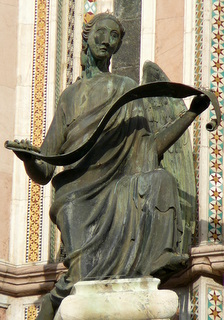
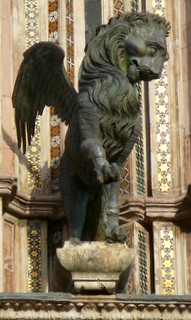
The marble pillars separating the Duomo's 3 sets of doors need 4
bronzes to hover over them. Christian Iconography does the
number 3 (e.g., Trinity) well, but the number 4 is a bit of a stretch.
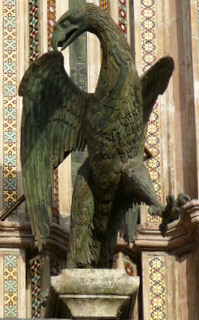
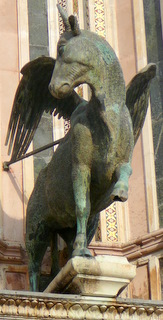
Typically it's populated by statues or symbols of the four Evangelists,
as seen here.
(Click on any of these pictures below to see screen size.)
|
|
|
|
| Angel of Matthew |
Winged Lion of Luke |
Eagle of John |
Winged Bull of Luke |
The symbols of Matthew, Mark,
Luke, and John bless the pillars they stand upon.
Like much of the mosaics and marbles, the Duomo's 4 large and 1 small
bronze statues are the work of an anonymous workshop in Orvieto.
[292]
However, many scholars feel that the cathedral's - master
architect (capomaestro) who designed the facade, Lorenzo
Maitani, is also responsible for
the eagle of Saint
John and the Angel of Saint Matthew.
[299,3009]
...and Doors
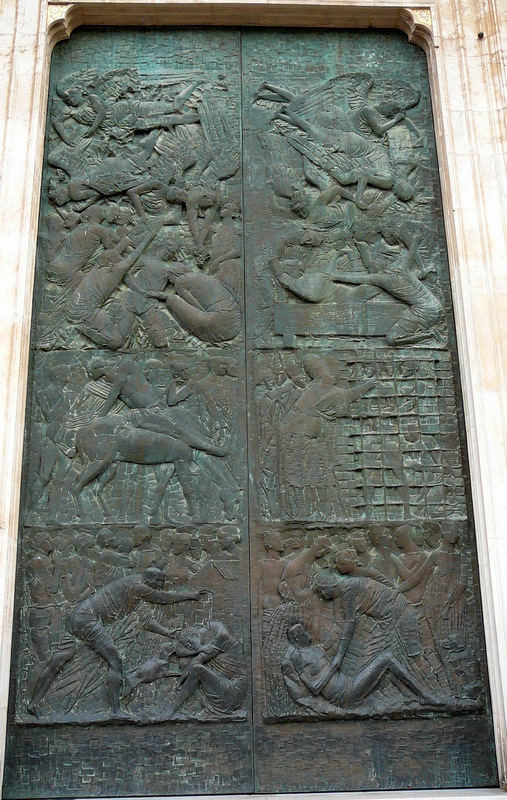
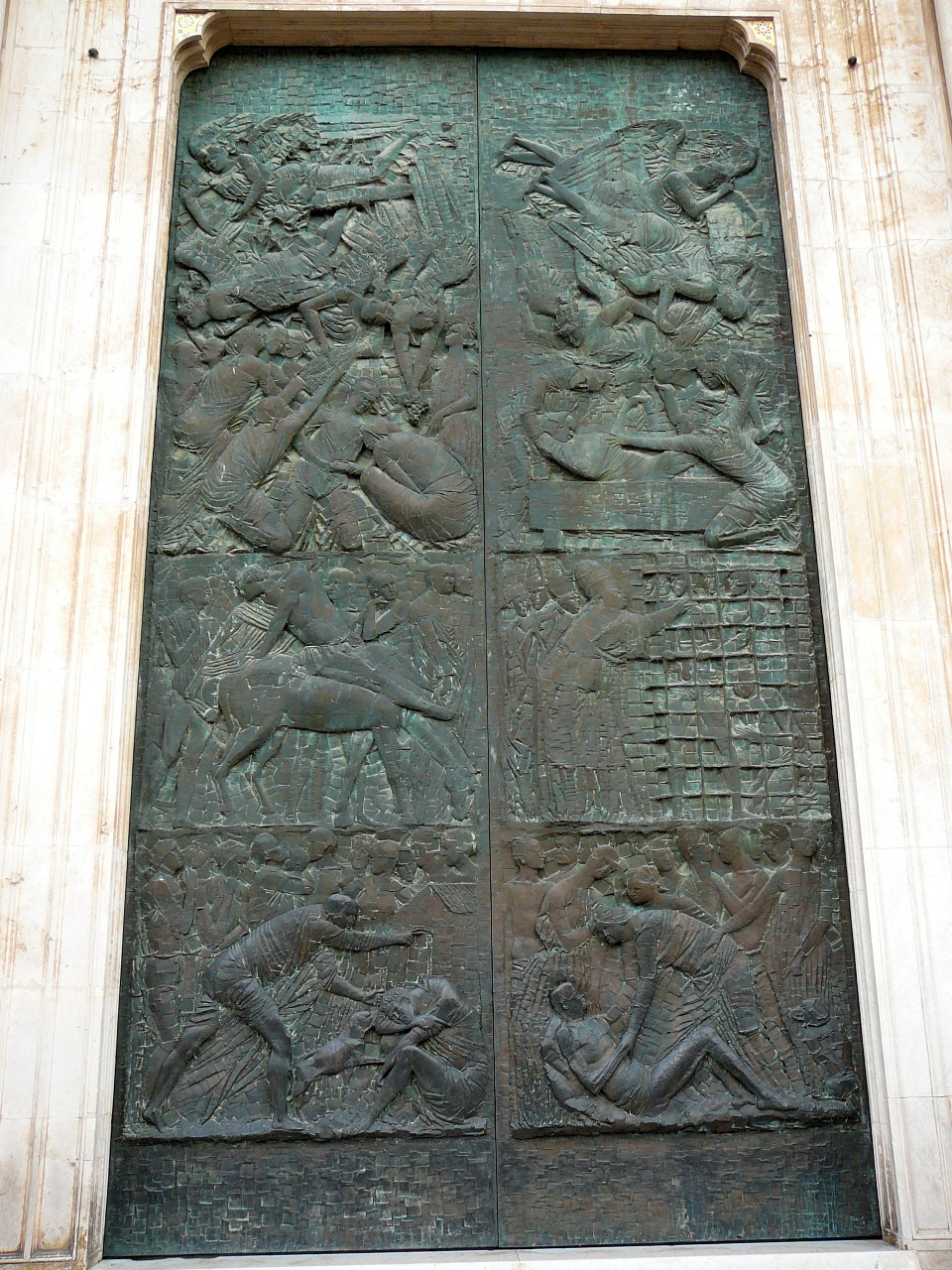
Six centuries later, the most recent enhancement to the facade is the
bronze door (1961-64) by the Sicilian sculptor Emilio
Greco (1913-1995). The central door is divided into
6 sections depicting the 7 corporal works of mercy. (See
photo at right).
Can you name them? The upper left cell feeds the hungry and
gives drink to the thirsty. To its right, angels help bury
the dead. Continuing clockwise we have visiting the
imprisoned, then visiting the sick at lower right, then sheltering the
homeless, and finally (at mid left) clothing the naked. See
more photos of the door
by clicking here.
The visiting of the imprisoned scene appears to depict a pope.
Was this John Paul II visiting (and forgiving) his
near-assassin
Mehmet Ali Ağca?
Probably not since that event happened in 1983, 13 years
after the doors went up in 1970. Unless, of course, we have more
prophets on these doors than we were aware of. Orvieto liked
Greco and vice versa; he donated several works in what is now a museum
here dedicated to his art.
We'll continue our visit of Orvieto's cathedral by examining the
architecture and the interior. Join us
by clicking here.
Into Cathedral
Facades? If so, click below for lots more pictures of these
Gothic masterpieces:

 belonged to those
bitter rivals who long tried to dominate each other and, in fact,
the whole Mediterranean: Siena and Florence.
But Orvieto? Not only did it lack the power of its rival
Tuscan cities, it also needed to import many of the artisans who worked
on its iconic cathedral. Typically Orvieto's Duomo was often built with
Sienese hands.[175]
The answer to why Orvieto though, is as simple as the cathedral is
complex. The answer is the pope.
belonged to those
bitter rivals who long tried to dominate each other and, in fact,
the whole Mediterranean: Siena and Florence.
But Orvieto? Not only did it lack the power of its rival
Tuscan cities, it also needed to import many of the artisans who worked
on its iconic cathedral. Typically Orvieto's Duomo was often built with
Sienese hands.[175]
The answer to why Orvieto though, is as simple as the cathedral is
complex. The answer is the pope.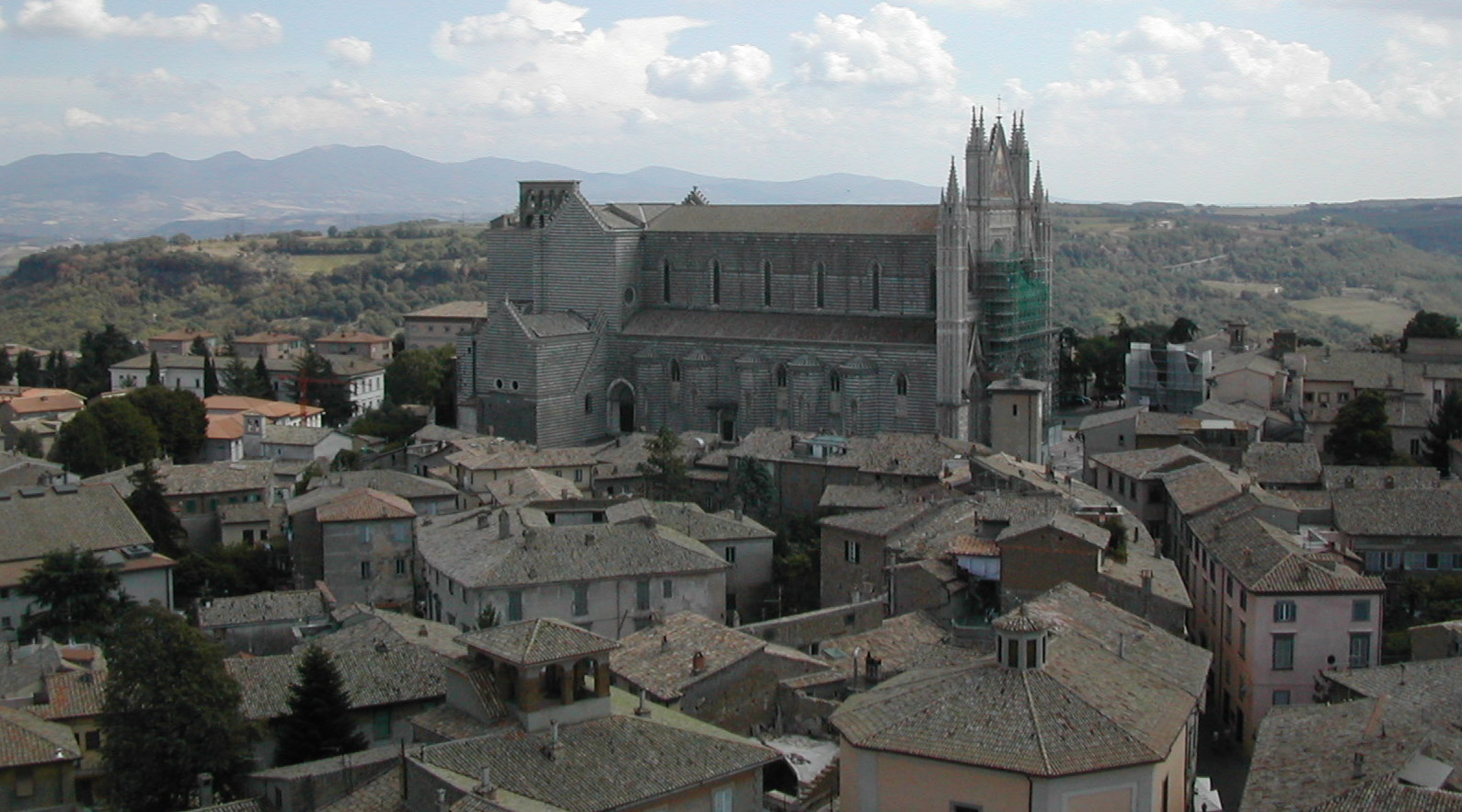
 [247]
[247]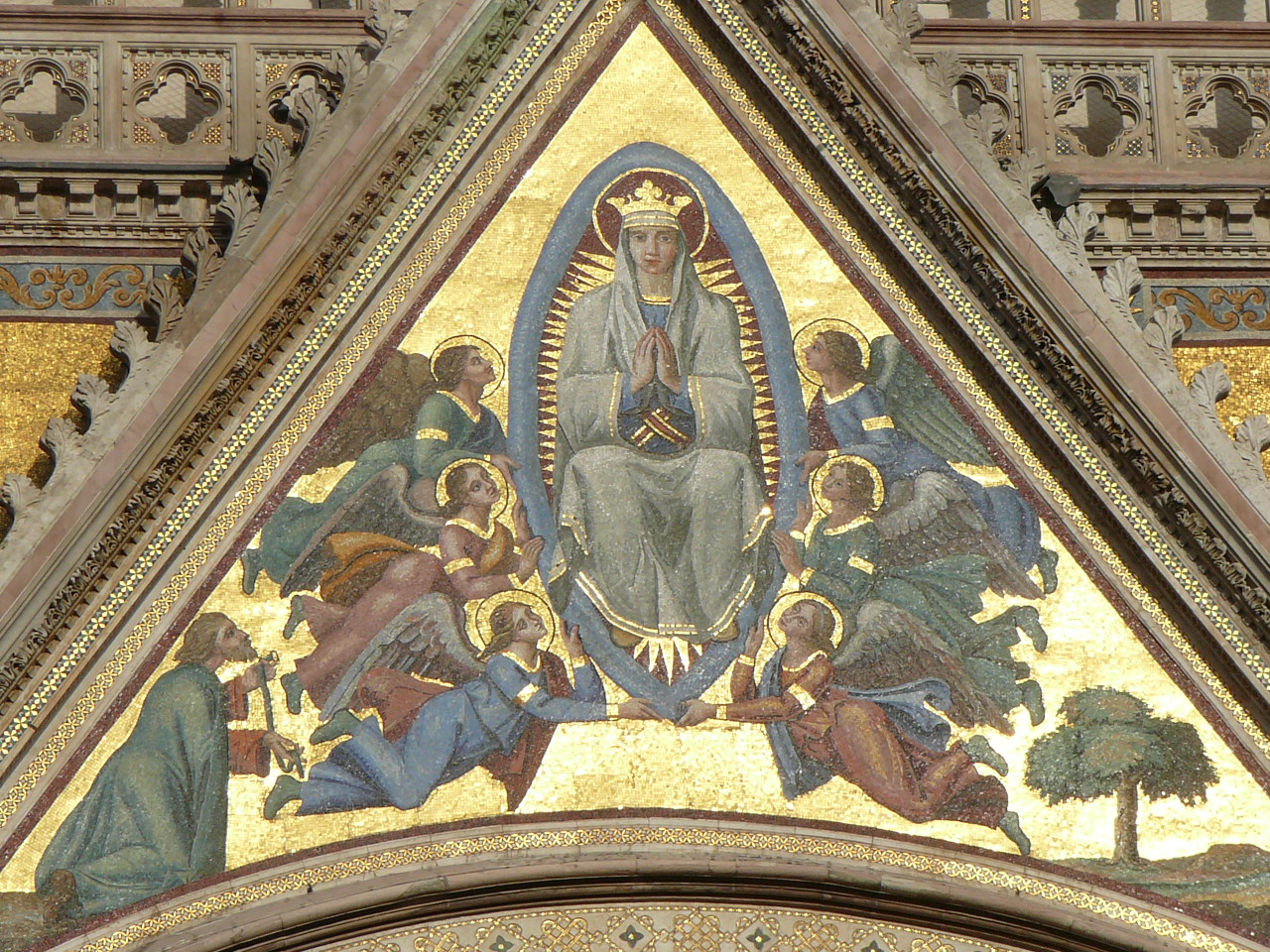




 the eagle of Saint
John and the Angel of Saint Matthew.[299,3009]
the eagle of Saint
John and the Angel of Saint Matthew.[299,3009]